Every field now remembers how it was looked after. While a crop grows, you can water it, feed it, test it and mulch it, and how well its soil was kept over the growing week decides the harvest: more of the crop, a Fine or Choice grade, and seed back to plant again.
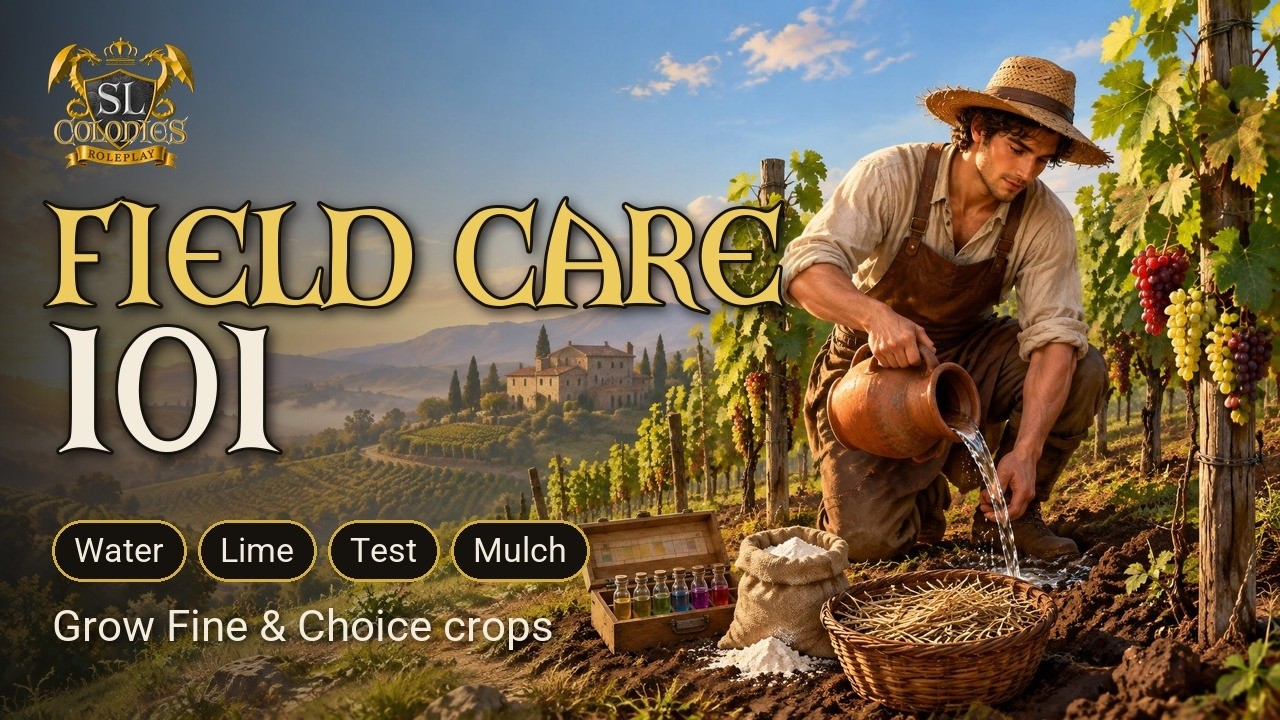
Our new Field Care 101 video walks through it end to end:
How it works
Touch a growing field and you’ll find a small care menu. Anyone the field’s security lets work it can use it, and it works on vineyards, fields, vegetable fields, wet fields and herb plots.
| Action | You need | What it does |
|---|---|---|
| Water | water and a worn clay jar | tops the soil’s moisture up (it never adds more than the field holds) |
| Amend | a fertiliser and a worn large bag | moves the pH: garden lime raises it, sulphur mulch lowers it, the fine kinds move it gently |
| Test | a worn soil kit | gives the exact pH and moisture, what the crop wants, and how the week is going |
| Mulch | reed and a worn small basket | halves the drying for two days |
| Assay | a vine assay kit (vineyards) | reveals one of the vine’s hidden genes, recorded in your Journal |
- One of each action a day. Care is a few visits a week, not a chore list.
- Each action costs a little energy.
- Nothing dies. A field you never touch grows exactly as it always has. Care only ever adds.
Reading your soil
The field’s hover text tells you how it feels: Thriving, Thirsty, Sour soil, Chalky soil, Waterlogged. A soil kit gives the exact numbers, and what the crop wants is something you find out by testing.
Every crop has its own wants. Grapes want pH 5.8–6.8 and moisture 35–85. A vineyard’s soil sits a little sour, so it’s a little lime that gets grapes into the band, not more water. Some crops want it drier; overwatering them leaves the field waterlogged, and that costs you.
Timing is the skill. Watering always fills to the same level, so you choose when to water, not how much. Water when the soil runs low, and mulch when it’s already where you want it.
What care pays
How long your field spends with its pH and moisture in the crop’s band over the growing week gives a care score, and the score decides the harvest:
- Fine: more crop, and seed back for certain, enough to replant.
- Choice: more again, and on a vineyard a cutting of the vine, for the Grafting Table.
Fine and Choice crops cook and brew into Fine and Choice dishes and drinks, which restore more when you eat or drink them.
Fields also remember what grew last. Rotating crops earns care points: a different crop family than last time helps, and a cereal after soybeans gets a nitrogen boost.
Your Journal
Everything your character learns is kept in your Journal on the website, at Your journal — SL Colonies Roleplay:
- Crops: each crop you’ve tested, what it wants and what you’ve seen.
- Vines: every gene your assays have revealed.
Each field you care for also has its own page, with its soil, its care log and its week.
Where things come from
- Soil kits and vine assay kits are sold by the Masters.
- Garden lime is made in the Compost Bin, from dung and chalk from the Chalk Pit.
- Water comes from your clay jar, and reed from gathering.
Make sure your fields have the latest scripts from the updater. Next up: the Grafting Table, where your vineyard’s cuttings become new grape varieties of your own. A video for that is on its way.
Happy farming!